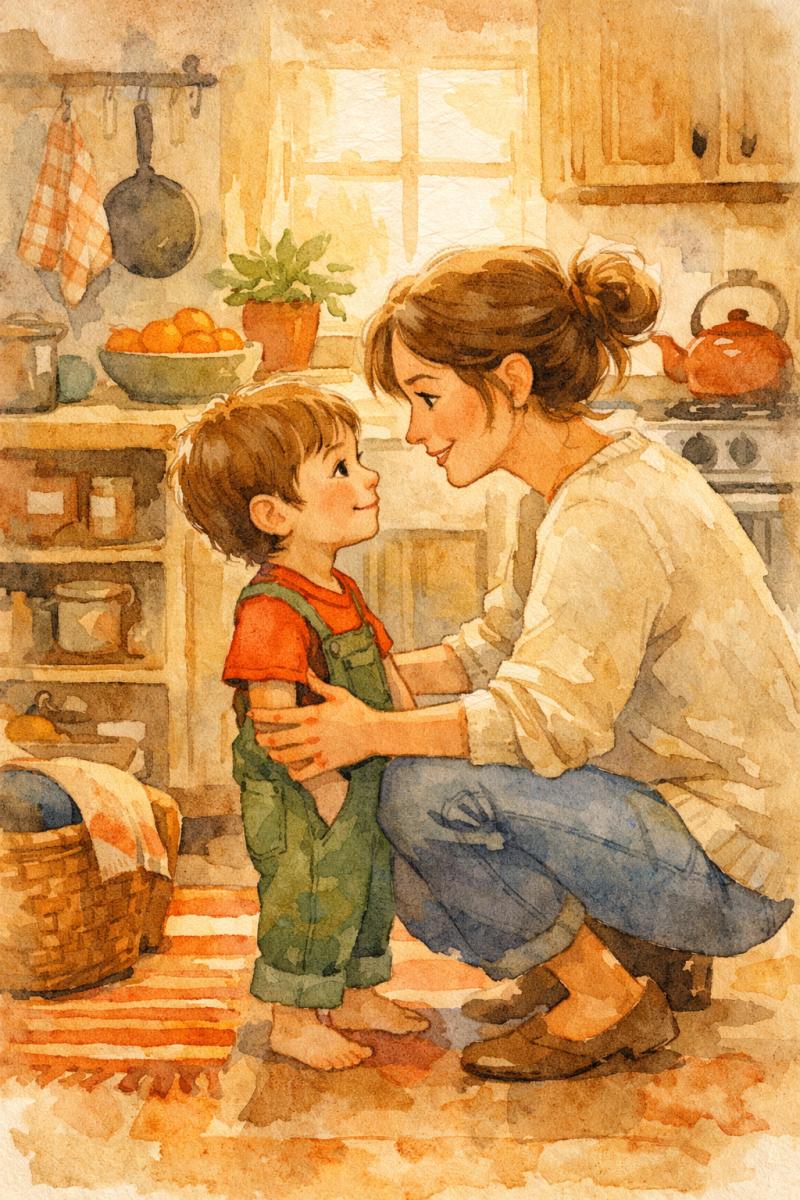
It happened on a Tuesday, in the backyard, in the part of the afternoon where the light goes a little gold. Rory was making a fairy house out of bark and rocks. I had my phone out, of course. I always have my phone out. She looked up at me and said, very plainly, "Can we just play without the camera today?"
I lowered it. I said okay. And then I sat there for a minute feeling like I'd been caught doing something I didn't realize I was doing.
If you're a parent, you almost certainly have a camera roll like mine. Tens of thousands of photos. Hundreds of videos. Birthdays, bath times, the first time they pronounced "spaghetti" right. We do it because we love them. We do it because we're afraid of forgetting. We do it because everyone does it, and a phone in your hand is a kind of muscle reflex now.
But somewhere in that beautiful instinct to remember, something else has happened. We are raising the most documented generation in human history. And I'm not sure they're getting more out of it than we are.
The Audience They Didn't Ask For
Kids notice the camera. By age four or five, most of them know exactly what it does and exactly what it means. The phrase "do it again" gets used a lot. So does "smile." So does "say it for the video."
And here's the part that's hard to admit: kids behave differently when they know they're being filmed. They perform. They self-edit. They become aware of themselves as a watched thing, sometimes before they've figured out who they are when no one is watching.
That's a heavy thing to hand a five-year-old.
Memory vs. Content
There's a quiet trade-off baked into every video we capture. The moments we film are the moments we don't fully experience. Our attention is split. Half of us is in the backyard with our kid; the other half is composing the shot, checking the framing, making sure the lighting is okay.
Researchers call this the "photo-taking impairment effect." When we photograph an experience to remember it, we tend to remember it less vividly than if we had simply lived through it. We outsource the memory to the device. The device keeps the file. We lose the feeling.
What our kids actually need from us in those moments is not a documentarian. It's a witness. Someone whose eyes are on them, not on a screen pointed at them.
Six Small Shifts Worth Trying
None of this means deleting your camera roll or never recording another birthday. Photos and videos are real gifts to a future self. The question is one of proportion, intention, and presence. A few practical adjustments that have helped in our house:
- The "first five" rule. When something special starts (a birthday party, a snowfall, a school recital), spend the first five minutes phone-free. Just be in it. After that, take a photo if you want.
- Set it on a tripod, then step into the moment. If you genuinely want a video of the recital or the backyard fairy-house build, mount the phone on a small tripod, hit record, and physically walk away from the device. Your hands are free. Your eyes are on your kid, not on a screen. You get the footage and the moment, and after a few minutes most kids forget the camera is even there.
- One shot, then away. Take a single picture, put the phone in your back pocket or another room, and rejoin the moment. Resist the urge to "make sure I got the good one."
- Camera-free corners of the day. Pick recurring slots that stay sacred. Bath time. The drive to school. The last ten minutes before bed. These are the small, ordinary moments your kid will remember most, and they don't need to be filmed.
- Watch how they change. The next time you pull out your phone around your kid, pay attention to what happens to their face. Does the spontaneity drop a notch? Do they pose? Do they say something for the camera they wouldn't have said otherwise? You'll see it.
- Ask them. Kids three and up are perfectly capable of telling you whether they want to be filmed. Try, "Do you want me to take a video of this, or do you just want me to watch?" Their answers are sometimes surprising and almost always honest.
The Childhood Behind the Camera
The truth is, most of us aren't oversharing because we're vain. We're doing it because we're tired, because we're scared time is moving too fast, because every previous generation got to forget and we're the first generation that has to actively choose to.
That's a real grief, and it deserves a little compassion. The point isn't to feel guilty about every video you've ever taken of your kid blowing out candles. It's to notice that there is a childhood happening behind the camera too, and that one is the one your kid is actually living.
That afternoon in the backyard, after I put the phone away, Rory built her fairy house for another forty-five minutes. She made a doorbell out of an acorn. She named the fairy. She told me a long, intricate story about the fairy's job, which apparently involves delivering messages to the moon.
I have no record of any of it. I just have the memory.
It turns out that's the thing she was actually trying to give me.